


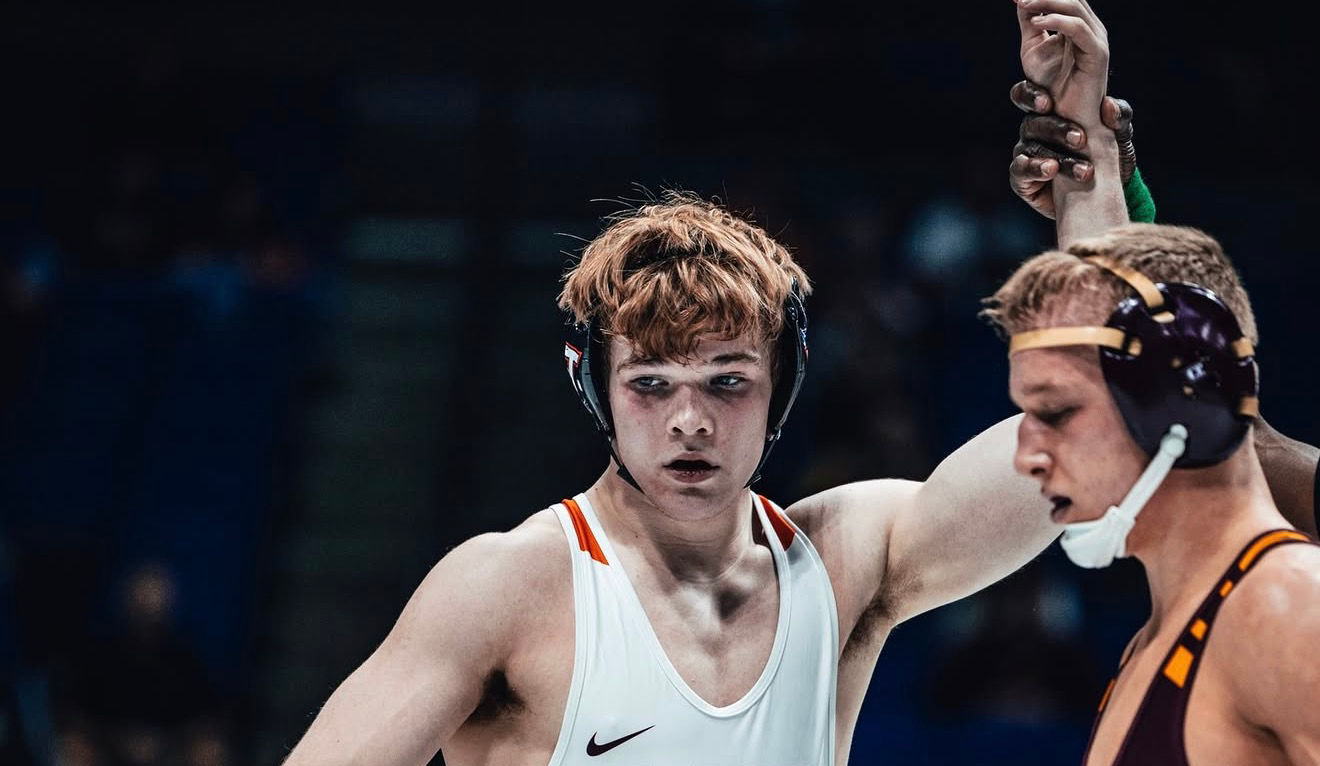
Nininger Brings His Wrestling Journey Back Into the Staunton River Room


Moneta, Virginia— Noah Nininger’s impact in the Staunton River wrestling room goes beyond the technical instruction he gives younger athletes. The four-time Virginia state champion and Virginia Tech wrestler enjoys running practices, putting wrestlers through lifts and sharing the details that helped him grow from a successful high school athlete into a Division I college wrestler. His time with the Staunton River program is not about revisiting past accomplishments. It is about working with younger athletes, helping them improve and offering an example of how wrestling, faith and daily discipline can shape a person well beyond the final score of a match.
During a recent practice, Nininger focused on one of the most important but overlooked areas in wrestling: position. The room worked on keeping elbows tight, winning the hand fight and eliminating the openings that allow an opponent to get to the legs. Nininger told the group, “Today we just kind of worked on holding better position. These guys, you know, they tend to keep their elbows out a lot, something I did a lot in high school and I think it’s a huge adjustment that makes a huge difference. Like if you can hold position, the guy doesn’t get to your legs, it’s a lot harder to lose a match.”
The next part of the practice was about responding when position is lost. Nininger taught wrestlers how to recover once an opponent gets through their hands, explaining, “When they beat our hands, we’re getting sprawls, we’re getting our legs back and running corner and finding our drags and finding that hamstring to get our takedowns.” His instruction was rooted in situations wrestlers see constantly in live competition. Instead of treating defense as a last resort, Nininger showed the group that a disciplined sprawl, good motion and a strong corner can create an immediate chance to score.

The former Golden Eagle also made time to lead a lift earlier in the day, another part of the work he enjoys doing with younger wrestlers. Nininger said, “It’s been amazing giving back. Like a lot of these little guys that I’ve been working with, I’ve been coming in. Like this morning I came in, put these guys through a little lift. It was a lot of fun, and just helping these guys jump levels is something that I hope to do when I’m older as well.” For Nininger, the value is not just in teaching one move, one drill or one workout. It is in seeing young wrestlers gain confidence, become more disciplined and begin to understand what it takes to improve.
Nininger has a strong foundation from which to teach those lessons. He was a four-time Virginia state champion at Staunton River and one of the program’s most successful wrestlers, finishing his high school career with a 110-10 record. He added national credentials with an Ironman championship, a Doc Buchanan finals appearance, Fargo All-American honors and Super 32 All-America recognition before heading to Virginia Tech. The accolades show the level he reached, but Nininger’s message during practice was built around the daily work that came before them: maintaining position, improving strength, learning from mistakes and continuing to compete when things do not go perfectly.
That has been especially important during his first season at Virginia Tech. Nininger wrestled at 149 pounds and received meaningful match opportunities, but he also faced early losses and an injury that ended his season before he could pursue the NCAA Championships. He said the year still gave him far more than a wrestling experience. “Yeah, I mean, it was a ton of fun. I love the guys at Tech. It’s an amazing culture, it’s an amazing place to be and I grew in all aspects of my life.” He said the Hokies’ room has accelerated his development because he trains with wrestlers such as Caleb Henson, Collin Gaj, Aaron Seidel, Ryan Burton, Bryce Andonian and now James Green. “All these guys are in my weight that are pushing me and it’s helped me jump levels so much,” Nininger said. “You saw me earlier in the season and I had some losses that weren’t so good. Yeah, I was losing matches that I definitely shouldn’t have, but I continued growing and then I got injured about halfway through the season, which really sucked. Cut my season short and I was really looking forward to going to Nationals, something I’ve watched my whole life.”
Rather than staying discouraged after the injury, Nininger kept moving forward. He entered the U23 National Championships, added size and finished third, an experience that helped build his confidence for the coming college season. He said, “We didn’t stop from there. I went to U23s, I put on a lot of weight and I had a fun tournament, fell a little short, got third, but ever since then I’ve been training with all those guys and I jumped levels again, gotten a lot bigger and I can’t wait for the season.” Nininger is now preparing to wrestle at 165 pounds, a significant move from the 149-pound class where he started his college career.
The move was not originally the plan. Nininger explained that he initially expected to compete at 157 pounds, but Virginia Tech coaches saw how quickly he was growing and asked him to take on the higher weight. “Originally the plan was 57 for me,” he said. “Caleb was coming back, so 49, we had a pretty tough guy there, so I was getting out of that weight and then they saw how fast I put on size and they were like, ‘Look, can you go 65?’ So, you know, I do what the coaches tell me. I went up to 65 and I’ve been feeling amazing.” He believes the move will allow him to perform with more energy because he will not be making the same kind of demanding cut. “I compete a lot better when I’m not cutting a lot of weight,” Nininger said. “My legs are fresh. I’m feeling great. I’m feeling strong now. U23s I was a little small, but I put on the size and I can’t wait for the season. I’m going to be a solid 65 this year.”
Nininger’s toughness was tested during the National Duals Invitational against NC State’s Jackson Arrington, a match in which he fought back for a major win. He said the result revealed the quality he wants to bring into every hard match. “Yeah, I mean, I always knew I was tough, right? Like I can fight. I love those long goes and fights where you’re just scrapping. Like today, it was a tough practice, we went hard and I just love digging deep and finding that extra gear.” He said he had experienced the same kind of lesson in the Virginia Tech room while wrestling Henson in a conditioning-style battle. “Caleb always reminds me, I was like, ‘I knew you were going to be good,’ because we went and we did a 40, first to 40 points, and Caleb beat me up so bad. He probably took me down seven times and it’s like 37 to four and I’ve got all escapes, and I snuck in a takedown at the very end. He probably got 40 points in about five minutes, but I got that last takedown, and that’s something that I’ll always have, is that fight.” Against Arrington, Nininger said, “I was definitely getting beat up quite a bit. He was big, strong, pushed me around, but I just found a way.”
The arrival of James Green at Virginia Tech has added another major source of instruction and competition. Nininger said Green’s experience at the international level immediately became visible in the way he approached the hand fight and created offense. “As soon as he got here, he was showing off how he gets into his hand fight, how he’s finding the snaps and how he’s getting off his shots with his sprawls,” Nininger said. “That’s something that’s been huge for me, being patient in that hand fight, finding their pressure and getting off of it.” He also understands the value of feeling that level firsthand, adding, “Wrestling with him, I mean, you can feel every bit of his pulling your neck. You’re getting so tired, and it’s just been an amazing partner to have to push me. He’s beat me up a little bit, doubles me through the mat a lot, but it’s been great to have him in the room.”
For all of the wrestling instruction and development that has shaped Nininger’s journey, his Christian faith has become the most important part of the way he views his life. He spoke candidly about how wrestling itself brought him to a deeper relationship with God. “Funny enough, I found the Lord through wrestling,” Nininger said. “I went to a tournament, didn’t do so good and that’s kind of—I put my identity in wrestling. So when I do bad at a tournament, it’s like my whole life’s ending, and I do bad at this tournament, I felt like I had nothing, everybody hated me and I was just done. Like my life was over.” That difficult moment led him to begin praying and reading the Bible, and he said the transition to Virginia Tech helped his faith grow even stronger.
“Once I got to Tech, it went to a whole new level because we’ve got an amazing team chaplain,” Nininger said. “He does Bible studies for us during the season. His name is Reed. You can check him out on Instagram, Gospel Underground. He’s been such a big help. After those Bible studies, he’d sit and talk to me 30, 45 minutes after them and just answer every question I had. And anytime I’d text him, he’d answer me. We’ve gotten lunch together and talked, and he’s just been a huge help for me.”
Nininger said the change in perspective has helped him understand a challenge that affects many athletes, especially wrestlers who invest so much emotion and effort into competition. “I think that’s just something that can help so many wrestlers because we get so invested in the sport and we put our identity in the sport,” he said. “And then that’s where things fall off. We think everything comes from winning and losing instead of putting our trust in the Lord and understand that He has a plan far beyond the wrestling mat.” He believes faith, prayer, church, Bible study and surrounding yourself with people who share those values can offer wrestlers a stronger foundation when performance does not go according to plan.
That foundation became even more meaningful for Nininger during the summer, when he spent time around high-level wrestlers who also shared his faith. “This summer, I had an amazing opportunity to be around these guys on the world team,” he said. “Ryan Burton, Bo Bassett, Aaron Seidel, they’d all come hang out at my house. We’d cook a nice meal and then afterwards, we’d do a Bible study. And that just helped all of us, and I saw a lot of change in the people around me as well as myself. I think that’s been an incredible summer.”
For the younger Staunton River wrestlers, Nininger’s practice offered much more than a session with a successful former athlete. They learned how to hold position, keep their elbows in, sprawl, recover their legs, run the corner and create offense from defense. They also heard from someone who understands the difficult parts of wrestling: losing matches he believed he should have won, dealing with an injury, moving up two weight classes, being pushed hard by elite training partners and feeling the pressure that can come with tying personal worth to results.
Nininger continues to chase major goals at Virginia Tech, and he believes the move to 165 pounds, the growth he has made in the weight room and the challenge of the Hokies’ practice room have prepared him for the next step. But his work with younger wrestlers shows that his goals extend beyond personal success. He wants to help athletes “jump levels,” not only by giving them the technical lessons that can help them win matches, but by sharing the toughness, perspective and faith that he believes can help them handle everything that comes with the sport.


Comments