


Aggressive, Patient, Intentional: Inside the Rise of North Carolina Wrestler Ethan Halstead
- Ryan Hayes

- Jun 7
- 9 min read

Pembrook N.C.— Some wrestlers are fine proving they’re good. Ethan Halstead is trying to prove he can be the best. He already has the kind of results that make coaches and fans pay attention, but he talks about them like they’re just the beginning. Every road trip, every tough practice, every national tournament—from Tulsa to Super 32 to NHSCA—is part of a plan he has in his head: to see how far he can really go.
That plan didn’t start with love at first sight. His older brother brought home a flyer for Lake Norman’s youth wrestling program, and at first Halstead wanted nothing to do with it. “The first couple months actually, I didn’t like it at all,” he said. “I was trying to make up any excuse not to go. But something just clicked later on. I don’t remember exactly when, but I just wanted to keep going and going. To this day, wrestling practice is the one thing that I look forward to every day. If I’m going to do something and I want to be the best at it, I’m going to put in as much work as I can.”
Now the Troutman, North Carolina native trains out of Darkhorse Wrestling Club and already looks like one of the best youth wrestlers in the country for his age. He has put together serious national results at the toughest events out there: he’s placed at Tulsa, stood on the podium at NHSCA, won a folkstyle national title in Indiana, and finished third at 105 pounds in the Super 32 middle school division. For most kids, that list is the story. For Ethan, it’s just the setup.
Ask him which tournament means the most and he doesn’t pick the one where he finished on top. “I would say probably taking third at Super 32,” Halstead said. “In the quarterfinals, I had a really tough opponent who I ended up losing to. I was really down, but I kept fighting and I came back and beat him for the true third match. That really just stuck with me and it made me remember that I can persevere through anything, and it really helped me make that bigger step.” Third at Super 32 is something kids dream about. He walked away proud, but also thinking about how to turn third into first.
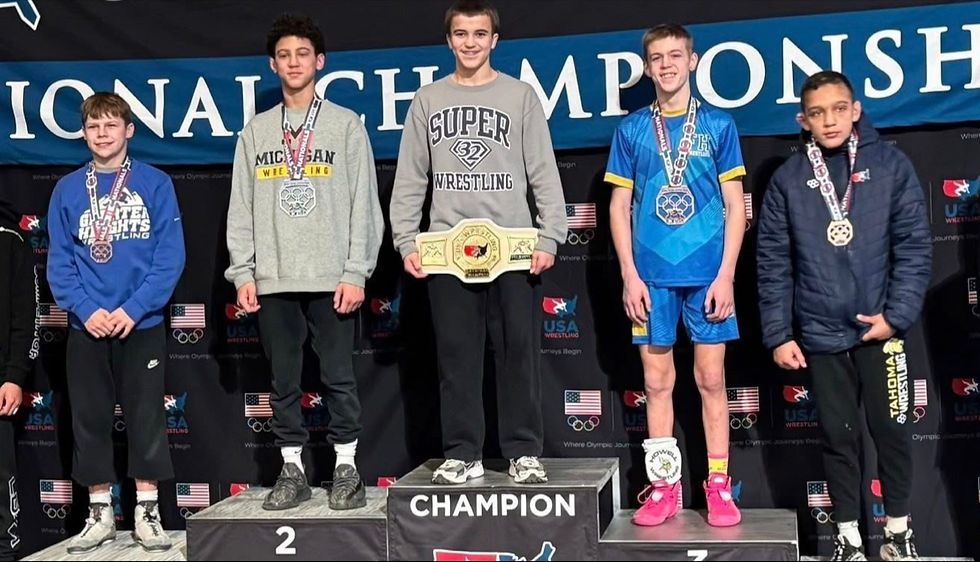
That’s how he looks at Tulsa, NHSCA, Super 32 and the folkstyle title, too. He’s proud of them, but he uses them to check where he’s at. “What I would always take away from those tournaments, whether I won or lost, is that I would always know that there was more work I could be putting in,” he said. “Just finding those small adjustments that I could look for and just learning how to become overall a better wrestler.” Even that folkstyle national title, which he won at 115, is something he keeps in perspective. “It did come with a lot of confidence,” he said, “but it helped me remember that’s not the pinnacle of where I want to be and the guys that I want to beat.”
When you watch him wrestle, it fits what he says. His results are full of tech falls and major decisions, not just tight wins. He sums up his style in three words. “If I had to put my wrestling into three words, I would put aggressive, patient, and intentional,” he said. “I would have to say I’m always 100% looking to score, but being like go‑go‑go has never always been exactly my style. I’ve always definitely liked to keep pressure on, but try to get them off‑balance and just set them up. And it usually ends up working out pretty well for me, getting a lot of points. Getting points, I think that’s really fun.” He’s not trying to survive matches; he’s trying to control them.
One of the weekends that really changed how he sees himself was the McDonogh duals. He was winning early and knew he had two matches coming that he’d been thinking about for a while: Noah Desmond and Nelson Villafane. “I was having a pretty good tournament,” he said. “I was, I believe, like 6 or 7–0 on the weekend. And then it was my last two matches. I had two that I really wanted to go there for—Noah Desmond and Nelson Villafane.”
Desmond is the younger brother of Penn State lightweight Nathan Desmond, who was a hammer on the national scene before heading to college. That kind of background sticks in a young wrestler’s head. “I’m going to be serious, I was nervous before that match ’cause I didn’t know how it was going to go or how he wrestled,” Halstead said. “But I just stuck to what I know, kept good position, and I ended up coming out majoring him. And that was just really, really cool to me because he was always somebody that I believed was like one of the people up there.” For a kid chasing “best,” it mattered that he didn’t just hang with that level—he pulled away.

Villafane, who wrestles for Mat Assassins, a premier club out of Pennsylvania, gave him a different kind of lesson. Halstead had heard over and over how tough he was. When they finally wrestled, Halstead was winning most of the way, right up until a late takedown. “I kind of remembered that,” he said of all the talk beforehand. “And then when I wrestled him and I was beating him until he got the last takedown, that really just showed me that I can be that guy. I just got to be a little smarter and always, always mentally there.” For someone who hates losing, that stuck. “I really just—I hate losing,” he said. “It really frustrates me whenever I lose. I just feel like letting people around me down or like letting them think less of me. I feel like it’s something I need to work on and realize that mostly everybody will respect me whether I win or lose. But having that mentality, I feel like, is what made me the most, ‘I got to win this match. I got to do everything right. I got to beat him.’”
His dad gave him a simple rule that fits with everything Halstead is trying to do. “One thing that helped motivate me would probably be my dad would always tell me that you can lose one,” Halstead said. “So if you lose one, why would you want to lose a second one? So that always kind of stayed in my head, and I would always just try my best to bounce back, dry my eyes, fix my head, and just take that anger out on the next guy.”
Even with all the wins and big‑name tournaments, Halstead is clear about what he wants people to notice first. “One of the most major things I want to be remembered for is the way I carry myself out on the mat,” he said. “It’s just that I’m always respectful and I never try to be cocky or anything like that.” He knows other kids can post clips of beating him. “I never really think that deep into it,” he said. “The people that are going to see that are never going to do what I want to do or what I’m doing. So I always kind of put that in perspective and know that I’m going to keep working my hardest so that when I wrestle that kid again and I smash him, I’m going to post that.”

Ask where this version of Halstead has been built, and he points straight at Darkhorse. “Like the team—Lukas (Cala), me, Mason (Brown), Carson (Raper), Jackson Thomas, everybody—we’re all, it’s all a big family,” he said. “Everybody’s just really cool with each other.” The coaches, he says, are a big part of why he’s where he is. “The coaches, I couldn’t ask for better coaches,” he said. “They’re always willing to help and always willing to go the extra step to help you reach your goals. I couldn’t imagine a place with a better heart and team‑like environment.”
Halstead reflected on having to face one of his own teammates in the semifinals at the National High School Coaches Association Nationals (NHSCA), noting how it added another layer of intensity to an already high-stakes stage this past March in Virginia Beach. Still, he didn’t shy away from the moment. “He’s my teammate, so there’s definitely respect there, but at the end of the day, we both know what’s at stake,” he said. “If I’ve got to wrestle Mason Brown to raise my status and prove where I belong, then that’s what I’m going to do. Iron sharpens iron, and competing against someone like him only makes both of us better.”
Right now, the idea of reclassing has moved from the back of his mind into a real choice. Reclass has been in the back of Halstead’s mind for a while, and he’s decided to go for it. He knows it means his friends will move on without him, but he sees that extra year as another chance to separate himself and chase the level he’s always talked about. “I never really thought that I would move away from my friends until like this year,” he said. “It really clicked that I probably wasn’t going to see a lot of them ever again, like hang out with them really. But, you know, I always thought to myself that yeah, I’m sure they all got goals. They all want to do good things. But I feel like my aspirations are to go do great things with my sport.” A lot of his friends play sports because they’re fun.
Halstead talks about wrestling as something more serious. “Some of the people that I was friends with weren’t exactly the most…like, they weren’t trying to go pro in their sport,” he said. “They were just doing it ’cause it was fun. And I totally understand that. But my goals, I always felt a little different because I always wanted to be the best at it, and I was never really around anybody except wrestlers that had that same mentality.”
Ask what he wants out of that extra year and he doesn’t waste words. “Probably win everything, get ranked,” he said. “I want to be, by the next rankings, I want to be number one, 100%. I want to be number one in the country ranking. I want to win every tournament, solidify my spot as being the best in the nation. Just because I’m not doing all this work just to be second or mediocre.” He sees that year as the time to sharpen things before going after high school Ironman, high school Super 32 and NHSCA, and as a bridge into more serious freestyle. Making world teams is part of what he wants, not just a dream he says out loud once.
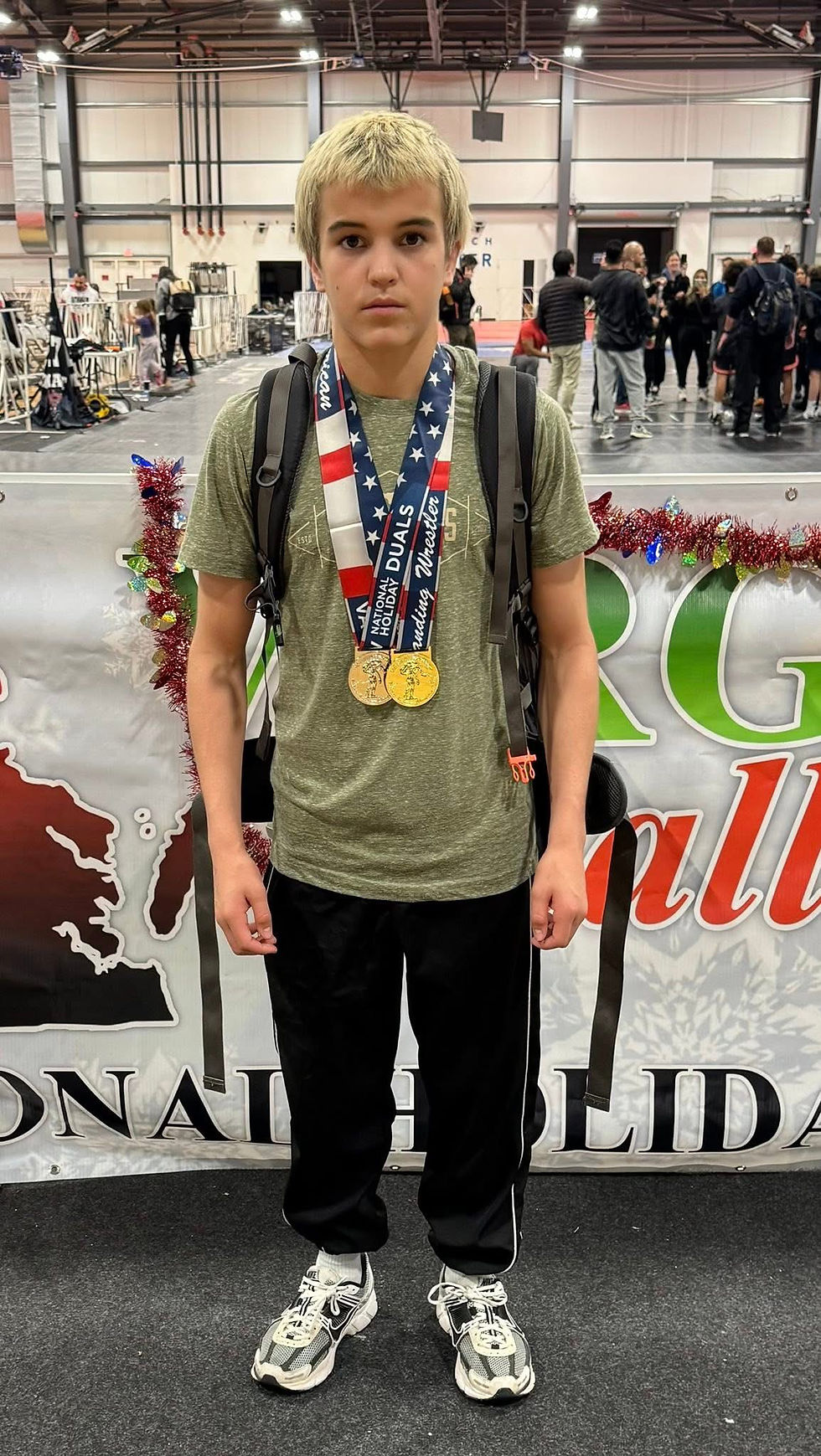
Technically, the thing he’s thinking about most right now is hand fighting. “One thing I feel like I need to work on is probably just being more intentional about my hand fight,” he said. “That’s a really big part of wrestling and dominating. I’ve definitely improved, I feel like, but if my hand fighting was top‑notch, I believe that would take me to the next level.” He builds that into his practices. “Every day in practice I’m going with the best guys, and I’m not taking as many shots,” he said. “The shots I want to get to in practice, I want to have good ones and stop making as many mistakes and have bad habits. So I’ll be trying to be more intentional, moving the guy where I want him and setting up my shots.” He studies the top guys, too. “You look at Bo Bassett, his hand fighting is definitely one of the best ones out there,” Halstead said. “All the people that I watch—Bo Bassett, Anthony Knox, Ben Davino, Jax Forrest, all them—they all have the best hand fighting.”
The next big stop on his calendar comes June 9–10 in Wesley Chapel, Florida, where Halstead will wrestle for North Carolina at the 14U National Duals, run by USA Wrestling. He wrestled that event last year and knows what’s coming: deep lineups from the top states in the country, long days of duals, and a lot of chances to prove himself. This time, he wants more out of it. He’s going back to Florida to build on last year’s finish, fix the little things, and turn close matches into blowouts. It’s another chance to “let everything fly,” to test himself against big names with a Team North Carolina singlet on and the Darkhorse crew behind him.
When he talks about the next five to ten years, he sounds like someone who has already thought it through. “At least win high school Super 32 at least two times, NHSCA at least two times, NCAAs at least one or two,” he said. “Be somebody that everyone can look up to and just really get motivated by watching them.” World teams are in that picture too. Right now, though, he’s still a youth wrestler with a reclass year in front of him, already one of the best in the country for his age, trying to turn “really good” into something much bigger. “Winning a state title, don’t get me wrong, that would be awesome,” he said. “Winning four, amazing. But in my eyes, those are stepping stones. I want to take it farther. I want to take it to the next level nationally.”


Comments